





It is important for children to learn how to sort objects according to their similarities and differences, as this will help them to understand how to group, and regroup, different objects. These skills are applicable throughout school, in topics such as biology, learning foreign languages, and exploring mixed media in art.
Sorting and classifying is a cognitive skill that humans have utilized for millennia. One of the most obvious uses of that skill is in our relationship to nature. For their survival, humans have had to learn what types of animals bite, what types of fungi are safe to eat, and what types of plants grow best in certain climates. Sorting allows us to see patterns, think logically, compare and contrast, and make adaptations to better refine our thinking. The development of this skill begins in early childhood, and is something that educators and caregivers can encourage through a variety of activities. This skill is often considered both a cognitive and an academic skill, as it is closely tied to STEM subjects. For example, biologists classify the magnificent creatures in the animal kingdom, chemists sort the elements on the periodic table, and statisticians might sort data according to many different factors.
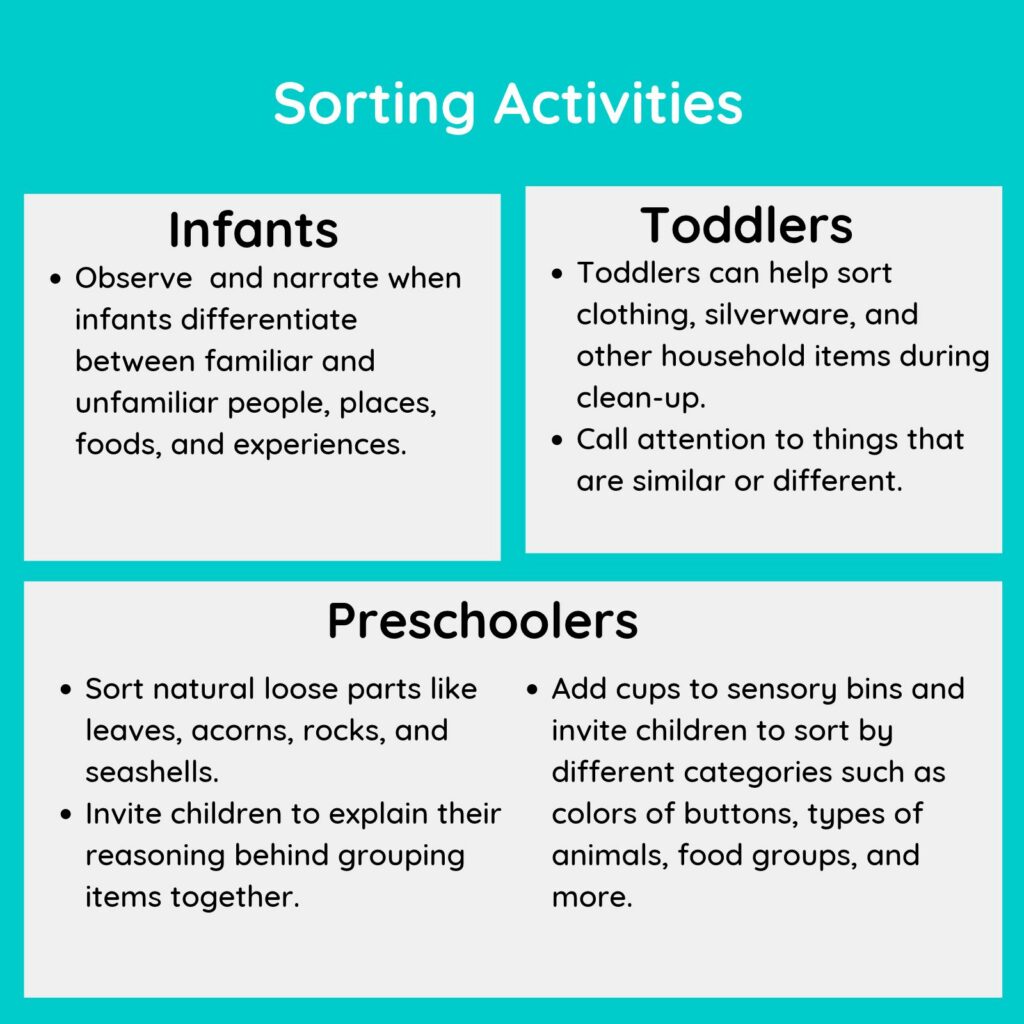
Children typically don’t start actively sorting objects until their toddler years, but the exploration of physical properties of items begins in infant years. Children place objects in their mouths to explore the shape, texture, size, and sensation of new objects. Educators and caregivers can make sure that they are choosing intentional and safe items with different temperatures, such as towel that has been in the freezer, or a texture, such as a toothbrush with its tickly bristles. This exploration is key for children’s future exploration of a larger variety of items that they might sort.
As children grow into their toddler years, they might start to explore sorting in conjunction with problem solving. For example, children love to explore the way shaped blocks fit into corresponding holes and enjoy exploring large puzzle pieces. Educators can support children by narrating and giving them language to describe how items are similar or different. In the younger years, it might be as simple as the color or the shape, but as children grow and develop their cognitive skills, they can begin to use more complex reasoning to explain how things are different. Educators can support the development of this skill through play! Rather than introducing worksheets that focus on just a narrow view of this topic, educators can explore the similarities and differences in the world that surrounds children. For example, educators can explore our “Foraging for a Woodland Habitat” activity to explore the different types of plant life in your backyard, or can explore different types of tools to smooth down wood with “Rough and Smooth Tree Bark”. They can also look to the pantry and supermarkets as a place where we often use sorting. For example, the “Stocking Groceries” activity is a great way to classify types of food. Then you can move outside with a fun sensory activity “Cleaning Dishes” where children prepare for a pretend party by washing and sorting dishes. Sorting can be fun, and satisfying, and can not only be useful for children’s future academic skills, but more immediately, with helping to clean up!
At Rayz Kidz, we’re here to support you, the make planning your week easy and your days joyful. To find activities that focus on opportunities for developing independence along with the other 29 important skills of early childhood development, explore the Rayz Kidz app and the Rayz Kidz curriculum.