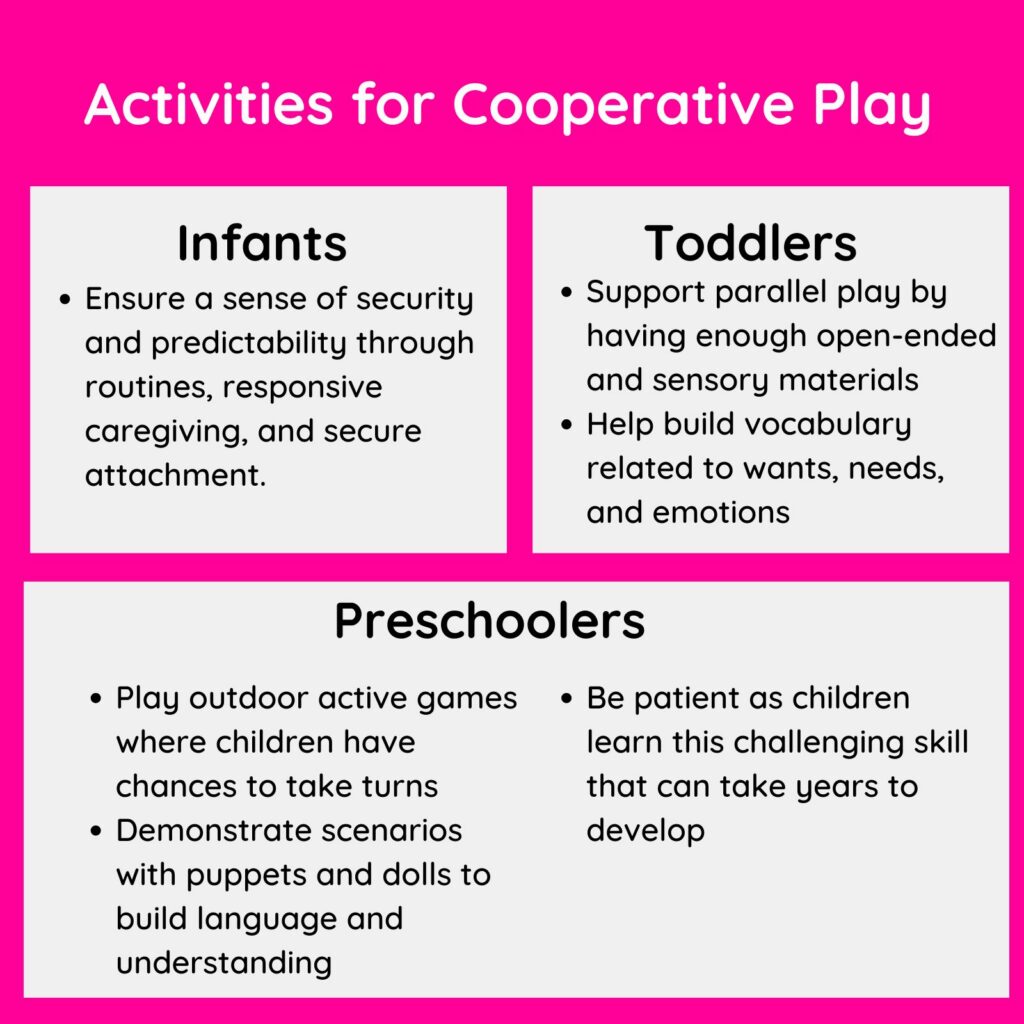





As children learn how to cooperate with their peers, they are learning a skill that will help them in a variety of environments as they grow. Children best learn how to take turns, share, and resolve conflict in low-stakes and playful situations with the guidance of a supportive adult. Adults can model the language of cooperation and provide children with problem-solving strategies. For example, when learning how to take turns, children may learn how to find another toy, ask their trusted adult to make a waiting list, or use a timer.
Humans are designed to work together in groups. We are closely dependent on one another for survival, as we work together to plant and harvest food, build shelters, defend ourselves and more. Cooperation with others is something that humans might work on for their entire lives, and this very important skill begins in early childhood. Cooperative play might include the ability to play peacefully side-by-side with peers, take turns, share toys, or negotiate and resolve social conflicts. This is one of the most important benefits of early socialization and high-quality early learning environments, as a strong foundation in these social skills allow children to navigate both academic and social life. This incredibly important skill is also one of the biggest challenges for early childhood educators, and can take years to learn how to guide children through this process. Children will often work through stages and work their way up to cooperative play in their later school years.
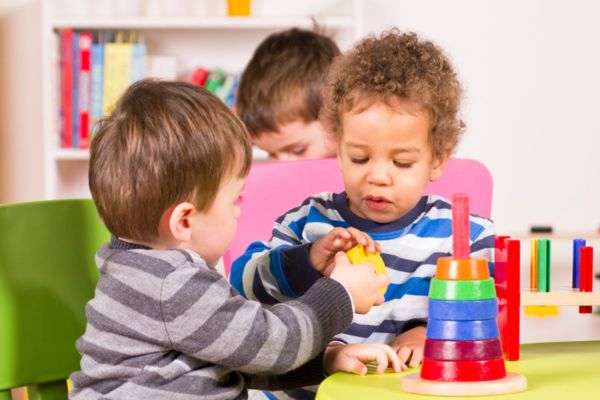
In early development, cooperative play consists of a strong basis in playful interactions with trusted adults. When infants meet each other, they may demonstrate curiosity about each other but will likely prefer to play alone, observe others, and stay close to a trusted adult. This is normal, and as children grow, the ways they first start to engage in cooperative play is through parallel play. Around 2 and 3 years old, children may play next to peers with their own sets of materials.
As children grow and develop language, they will also start to interact more with other children, which is when the work of teaching the social skills related to cooperative play becomes extremely important. Cooperative play is closely tied to children’s language skills as well. Indeed, many educators might feel as if they need to guess what the reasons are behind any given conflict as children are developing language. Children need language to invite a peer to play, to express frustration that they have not had a turn with a favorite doll, or to ask for some personal space during circle time.
Conflict will always happen in early childhood environments, but there are also things that educators can do to give children more wiggle room for their colorful emotions and needs. Educators can reflect on what might feel high-stakes for a child and what feels like low-stakes. For example, if children are playing with sticks or leaves, there is usually an abundance of this type of material outdoors, and if a child decides that they like a stick that a peer is playing with, there might be lots of sticks to choose from, and thus feels low stakes. However, if playing indoors and children begin to argue over a favorite doll, this might take a bit longer to help children to regulate, and will feel more high-stakes. Educators can thus intentionally select activities and create learning environments that encourage teamwork and cooperative play. If there are specific times of day that children seem to be more sensitive, this can lead to more conflict over preferred toys or personal space. Thus, educators might ensure that children have long periods of outdoor play, so that they can expend excess energy through movement and engage in play with sensory play. Outdoor learning environments have more space to move our bodies, and there are more loose parts that children might play with. Or, perhaps educators can work make a plan to teach a social skill during a circle, with visuals, puppets, a favorite book, and then they can design activities where the children might get to practice the language associated with cooperative play and problem solving skills. For example, an educator might read “Hands Are Not For Hitting” by Martine Agassi, paired with our “Gentle Hands” activity so children can engage in positive activities that involve using our hands in safe and productive ways.
Educators can intentionally facilitate activities that create an environment for cooperative play. The Rayz Kidz curriculum includes many of these activities, such as a shared sensory bin, “Shaving Cream & Ice” where children move around melting colored ice blocks and games such as “Who Took the Cookie” where children can practice taking turns or “Simplified Senet” where two players compete to get all of their pieces off the board.
At Rayz Kidz, we’re here to support you, the make planning your week easy and your days joyful. To find activities that focus on opportunities for developing independence along with the other 29 important skills of early childhood development, explore the Rayz Kidz app and the Rayz Kidz curriculum.